
Engineering Flexibility on Demand: How Containerized Maglev Turbo Blower Stations Are Transforming M
Post time: 2026-10-12 14:52:03
For municipal utility directors, civil engineering consultants, and industrial plant expansion managers, the timeline from project conception to active operation is often constrained by civil construction bottlenecks. Whether a municipal wastewater treatment plant requires emergency capacity expansion or a remote industrial processing facility demands decentralized aeration, constructing permanent concrete blower buildings involves lengthy permitting, heavy civil construction, and substantial capital outlays.
To bypass these traditional infrastructure delays, modern engineering teams are increasingly turning to modular, containerized deployment strategies. Drawing from decades of frontline field engineering and system integration experience, our technical specialists have observed how housing advanced turbomachinery within pre-engineered, climate-controlled mobile enclosures redefines plant agility. Let us explore this rising industry trend through an expert Q&A exploration of how containerized maglev turbo blower systems deliver rapid deployment, elite acoustic control, and seamless operational reliability.
Expert Q&A: Unlocking the Operational Benefits of Containerized Maglev Systems
Q1: Why are municipal utilities and industrial plant managers rapidly adopting containerized blower stations?
Answer: Traditional blower installations require dedicated brick-and-mortar mechanical rooms, extensive concrete foundational pours, complex acoustic ducting, and on-site electrical wiring that can stretch project timelines over many months. Containerized solutions package the entire air delivery ecosystem—including the maglev turbo blower, variable frequency drive cabinets, master control panels, and multi-stage air filtration—into a pre-wired, factory-tested, weather-resistant steel enclosure. This plug-and-play approach slashes on-site installation time from months to mere days, allowing utilities to scale aeration capacity rapidly in response to sudden population growth or stringent regulatory deadlines.
Q2: How does containerized architecture address the stringent acoustic noise challenges faced by modern industrial plants?
Answer: Noise pollution control is a major operational hurdle for industrial facilities situated near urban residential zones or operating under strict environmental health regulations. Legacy positive displacement blowers generate high-frequency mechanical noise and heavy vibration that require massive, cumbersome acoustic hoods and specialized sound-dampening civil structures. In contrast, maglev turbo blowers eliminate internal mechanical friction through active magnetic levitation and permanent magnet synchronous motor design, resulting in inherently low operational vibration. When housed inside a sound-attenuated containerized enclosure equipped with specialized acoustic louvers and internal baffling, noise levels drop significantly, allowing plants to comply effortlessly with strict urban noise ordinances without requiring secondary sound walls.
Q3: What thermal and environmental engineering considerations ensure 24/7 reliability inside a mobile container?
Answer: Deploying sensitive high-frequency power electronics and high-speed turbomachinery inside a sealed mobile enclosure requires rigorous thermal management architecture.
Automated Climate and Ventilation Control: Containerized units integrate intelligent forced-air ventilation, automated louver shutters, and internal space heating to maintain optimal micro-climates regardless of external weather extremes, preventing condensation in humid coastal environments or freezing in sub-zero winters.
Heavy-Duty Inlet Air Filtration: Mobile stations incorporate multi-stage, high-efficiency intake filtration packages that protect high-speed 3D-contoured titanium impellers from airborne dust, sand, and industrial particulates.
Integrated Power and Safety Interlocks: Pre-wired electrical distribution panels feature robust surge protection, harmonic filtering, and emergency ventilation overrides, ensuring that the enclosed system operates safely and autonomously during remote industrial deployments.
Frequently Asked Questions on Containerized Blower Stations
1. Can containerized maglev blower stations be easily relocated if plant capacity needs shift?
Yes. Because all components—including piping connections, power distribution, and digital control panels—are pre-engineered within a self-contained structural skid, the entire unit can be uncoupled, hoisted by standard crane equipment, and transported to a new location or secondary basin as municipal demand evolves.
2. How do containerized units handle extreme weather conditions during outdoor operation?
Containerized enclosures are constructed using marine-grade structural steel, corrosion-resistant coatings, and weather-sealed access doors. Integrated internal climate control systems ensure that variable frequency drives and digital controllers remain protected against humidity, salt spray, and extreme temperature fluctuations.
3. Are containerized maglev blowers compatible with existing plant supervisory control systems?
Yes. The internal master programmable logic controllers (PLCs) support standard industrial communication protocols, allowing operators to monitor and control airflow rates, temperature telemetry, and system status remotely through existing plant supervisory control and data acquisition (SCADA) networks.
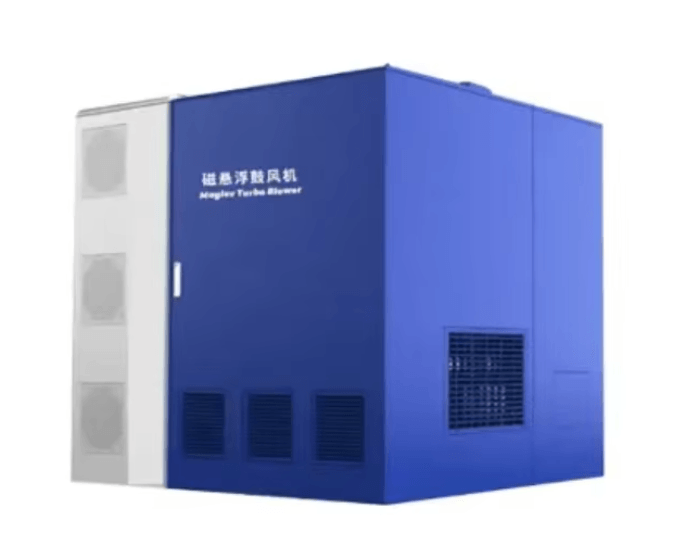
Maglev Turbo Blowers Product Information
Web: http://www.greentechblower.com (Group Web) ‖ http://www.zqblower.cn (Chinese) ‖ http://www.ringblower.cn/ (Ring blower) ‖ http://www.china-blower.com (Roots Blower) ‖ https://www.zibovacuumpump.com (Vacuum Pump)