
Analysis of Variable Frequency Regulation Technology for Air-Suspended Centrifugal Fans
Post time: 2026-09-20 15:08:42
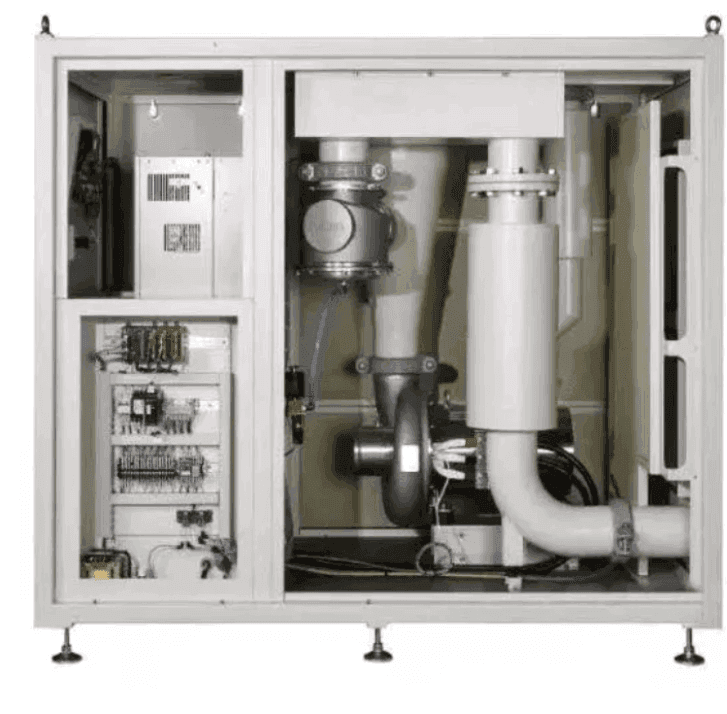
Air-suspended centrifugal fans are a new type of fan equipment that uses air bearing technology to achieve high-speed, contactless operation of the impeller. They feature low operating noise, low mechanical losses, and reduced maintenance requirements. With the increasing demand for industrial energy efficiency, variable frequency regulation technology is widely applied to air-suspended centrifugal fans. By adjusting the operating frequency and rotational speed of the motor, the fan's airflow and pressure can be matched to actual demand, thereby reducing unnecessary energy consumption.
1. Basic Principle of Variable Frequency Regulation
1.1 Airflow Regulation Through Speed Adjustment
Air-suspended centrifugal fans generally use high-speed permanent magnet synchronous motors for drive. The variable frequency drive can adjust the motor operating frequency according to control signals, thereby changing the impeller speed. When the system requires less airflow, the fan speed can be reduced to decrease air delivery. When demand increases, the speed can be raised accordingly.
According to the affinity laws for centrifugal fans, within a certain operating range, airflow is approximately proportional to rotational speed, pressure is approximately proportional to the square of rotational speed, and shaft power is approximately proportional to the cube of rotational speed. Therefore, reducing the speed under low-load conditions can produce significant energy savings.
1.2 Dynamic Matching of Operating Conditions
When traditional fans regulate airflow through throttling valves, the motor may continue operating at a relatively high speed even when airflow demand decreases, resulting in part of the energy being consumed by system resistance. Variable frequency regulation changes the fan speed directly at the power source, allowing the output capacity to better match actual demand.
2. Main Control Methods
2.1 Constant Pressure Control
Constant pressure control is one of the common control methods for air-suspended centrifugal fans. A pressure sensor continuously monitors the pressure in the pipeline system and compares the actual pressure with the preset value. The controller then adjusts the fan speed according to the pressure deviation to maintain the system pressure within a suitable range.
This method is suitable for aeration systems, centralized air supply systems, and industrial applications requiring stable air pressure.
2.2 Multi-Fan Coordination Control
For systems using multiple air-suspended centrifugal fans, the control system can coordinate the operation of several units. According to the total airflow demand, the system automatically adjusts the number of operating fans and the speed of each unit, allowing the fans to operate within relatively efficient operating ranges.
Through reasonable master-slave control, alternating operation, and load distribution, the system can also reduce the impact caused by frequent starting and stopping while improving overall operating stability.
3. Energy-Saving Advantages
3.1 Reducing Energy Consumption Under Low Loads
In practical applications, air-suspended centrifugal fans do not always operate at full load. With variable frequency regulation, the operating speed can be reduced according to actual working conditions. Since fan shaft power has a nonlinear relationship with rotational speed, reducing speed appropriately can generally achieve considerable energy savings.
3.2 Reducing Mechanical Losses and Maintenance Requirements
Air bearings reduce contact friction during operation compared with conventional mechanical bearings. Combined with variable frequency control, the equipment can adapt more smoothly to different loads. Proper control of starting, acceleration, and deceleration can help reduce system impact and improve operating conditions.
4. Considerations for Variable Frequency Applications
4.1 Proper Parameter Configuration
The frequency range, acceleration and deceleration time, pressure setpoint, and protection parameters of the variable frequency drive should be configured according to the fan model and system operating conditions. Improper parameter settings may result in frequent adjustments, pressure fluctuations, or even unstable equipment operation.
4.2 Overall System Matching
The energy-saving performance of variable frequency regulation depends not only on the fan itself but also on pipeline design, air-consuming equipment, and control strategies. Therefore, actual projects should comprehensively consider system resistance, air consumption curves, and equipment efficiency.
5. Conclusion
Combining air-suspended centrifugal fans with variable frequency regulation technology allows the operating speed to be flexibly adjusted according to actual demand, enabling precise control of airflow and pressure. With appropriate control strategies and overall system matching, this technology can reduce energy consumption during low-load operation while improving the automation and stability of air supply systems. As industrial energy efficiency and intelligent control technologies continue to develop, variable frequency regulation will play an increasingly important role in air-suspended centrifugal fan applications.
Air Suspension Blowers Product Information
Web: http://www.greentechblower.com (Group Web) ‖ http://www.zqblower.cn (Chinese) ‖ http://www.ringblower.cn/ (Ring blower) ‖ http://www.china-blower.com (Roots Blower) ‖ https://www.zibovacuumpump.com (Vacuum Pump)