
Mastering Fluid Dynamics: 3D-Contoured Impeller Aerodynamics in Maglev Turbo Blowers
Post time: 2026-10-19 14:08:49
When evaluating the engineering excellence of high-speed turbomachinery, attention often gravitates toward advanced magnetic bearings or permanent magnet motors. However, the true heartbeat of any pneumatic delivery system lies within its fluid-compression core. Transforming high-speed rotational kinetic energy into stable, high-pressure process air requires sophisticated aerodynamic engineering. In conventional blowers, simplified two-dimensional blade geometries create flow turbulence, vortex separation, and parasitic energy losses.
Drawing from decades of frontline field engineering, fluid dynamics research, and aerodynamic testing across municipal and industrial installations, our technical teams have observed that impeller design dictates the ultimate boundary of energy efficiency. Let us examine the advanced aerodynamic principles and 3D-contoured blade mechanics that allow modern maglev turbo blowers to achieve elite polytropic efficiency and exceptional fluid-handling performance.
The Aerodynamic Mastery: How 3D-Contoured Impellers Maximize Polytropic Efficiency
Achieving stable, high-efficiency air compression at rotational speeds scaling up to 100,000 RPM demands meticulous control over compressible fluid behavior.
Three-Dimensional Blade Profiling: Modern maglev turbo blowers utilize precision-machined, 3D-contoured titanium impellers featuring complex, spatially twisted blade geometries that match the exact vector requirements of incoming air streams, ensuring smooth fluid acceleration and minimal shock losses.
Boundary Layer Flow Control: By optimizing blade curvature and hub-to-shroud contour ratios, advanced aerodynamic design prevents boundary layer separation and localized stall conditions, maintaining stable laminar airflow even during rapid turndown modulations.
Polytropic Efficiency Optimization: Advanced fluid-dynamic profiling ensures that input mechanical energy is converted directly into useful static pressure rather than wasted heat, maximizing wire-to-water efficiency across continuous industrial operating cycles.
Expert Q&A on Impeller Aerodynamics and Fluid Flow Mechanics
Q1: Why are 3D-contoured impellers vastly superior to traditional 2D radial blades in industrial blowers?
Answer: Traditional two-dimensional radial blades feature straight, uniform blade geometries that struggle to guide high-velocity air smoothly across changing flow angles, resulting in severe turbulence and vortex formation at the blade tips. In contrast, 3D-contoured impellers feature complex, three-dimensional curvature that guides air molecules seamlessly along natural flow paths. This eliminates secondary flow eddies, reduces internal aerodynamic drag, and significantly boosts overall polytropic efficiency.
Q2: How does high-grade material selection impact the structural integrity of high-speed impellers?
Answer: Operating at extreme rotational velocities subjects impeller blades to intense centrifugal stresses and aerodynamic loading. To withstand these forces without micro-structural deformation, premium maglev turbo blowers are manufactured from forged titanium alloys or high-strength aerospace-grade aluminum. These materials provide an exceptional strength-to-weight ratio, ensuring the impeller maintains its precise aerodynamic profile and tight dimensional tolerances throughout decades of continuous high-speed duty.
Q3: What role does the volute and diffuser casing play in converting velocity energy into static pressure?
Answer: An impeller accelerates ambient air to extreme velocities, but process applications require static pressure rather than raw kinetic speed. The surrounding scroll volute and stationary diffuser channels act as precision deceleration zones. As high-velocity air exits the spinning impeller tip, the expanding geometry of the volute gracefully slows down the airflow, converting kinetic energy into stable static pressure headers required for wastewater aeration and industrial pneumatic transport.
Frequently Asked Questions on Blower Aerodynamics
1. How does inlet air temperature and barometric pressure affect impeller aerodynamic performance?
Changes in ambient temperature and barometric altitude alter air density, which directly impacts mass flow output and pressure generation. Modern maglev turbo blower control systems automatically compensate for these environmental variables by modulating motor speed via variable frequency drives to maintain constant mass flow rates.
2. Can dust accumulation on impeller blades degrade aerodynamic efficiency over time?
Yes. Over extended operating periods in dusty environments, particulate accumulation on blade surfaces can disrupt laminar airflow. This underscores the critical importance of maintaining high-efficiency multi-stage inlet air filters to protect the 3D impeller contour and preserve peak efficiency.
3. How do engineers test and validate the aerodynamic performance of custom turbo impellers?
Manufacturers utilize advanced computational fluid dynamics (CFD) modeling combined with rigorous closed-loop dynamometer testing test rigs. These facilities measure exact mass flow, pressure differentials, and shaft power consumption to verify that every impeller meets strict aerodynamic performance criteria before field deployment.
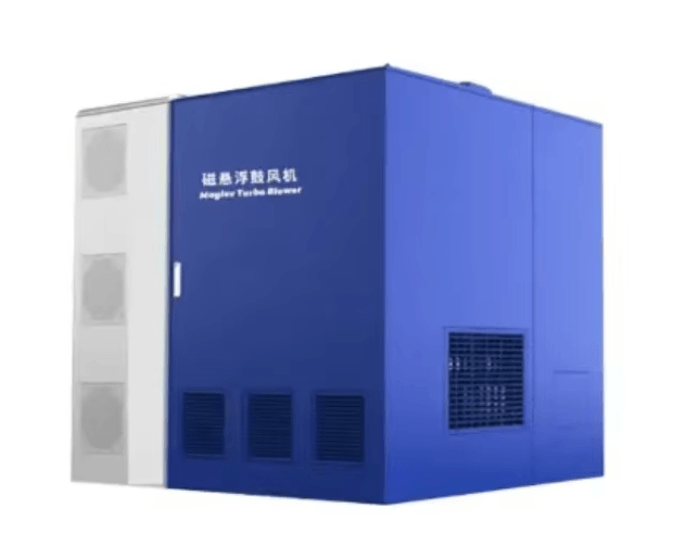
Maglev Turbo Blowers Product Information
Web: http://www.greentechblower.com (Group Web) ‖ http://www.zqblower.cn (Chinese) ‖ http://www.ringblower.cn/ (Ring blower) ‖ http://www.china-blower.com (Roots Blower) ‖ https://www.zibovacuumpump.com (Vacuum Pump)